You don’t know how to tie your shoes

It turns out nearly all of us have been tying our shoes wrong since we learned. I’ve done it the way this guy does it now for a week and it really works–no more double knots and it still stays tied.

Posted in Uncategorized | Leave a comment

One way exercise might boost memory

It’s been shown for a while that exercise leads to increased production of nerve cells, and that exercise improves brain function. Tara Parker Pope writes about a study in which people were given memory tests while in an imaging machine, and the researchers found that those better at remembering had more activity in the dentate gyrus. The dentate gyrus is one of the areas in which exercise promotes new brain cell growth, so this area may be at least of the links between brain power and muscle power.

Posted in Brain Hacking, Diet and Exercise, Uncategorized | Leave a comment

Venture Capital and Intelligence Tech

As part of my story on Michael Crow, I recently interviewed Christopher Darby, the president of a company called In-Q-Tel (Crow is chairman of the board), which has been around for about ten years, although I had never heard of it. In-Q-Tel is a fascinating new chapter in the story of the evolution of top secret research. It is a venture capital company started by the CIA.

Historically, when the defense or intelligence community wanted to develop a new technology they went to their contractors and asked them to work on a new spy plane or a new bugging system. This was the origin of groups like the famous Lockheed “Skunk Works,” which developed the U2. DARPA, the Defense Advanced Research Projects Agency, gives out grants for promising research. This was how the internet, which was orginally called DARPAnet, was invented (the idea was to create a system which would allow the transmission of information even though nuclear bombs had taken out many of the nodes and lines of communication).

The trouble with these old ways of doing things is that they rely on someone having an idea for something and asking someone else to develop it. But as Michael Crow said, technology is moving just too fast for anyone too keep up with all the possible ideas out there. New ideas may come up and shrivel on the vine for lack of support before the intelligence community even knows they exist.

So the CIA set up In-Q-Tel. On the one hand it’s like any other venture capital firm. People come bearing ideas for businesses, seeking financial support to help the business start and grow. But on the other hand they are quite upfront about the proposition that they are looking for ideas that will help them collect and analyze information better (although some of the companies they support seem to be more on the defense than intelligence side – you can’t really know for sure). With In-Q-Tel, the CIA is plugged into all the latest ideas and able to spot the ones that may be useful for the work they do. Many of the ideas that might otherwise bloom briefly and die can now get financial support that allows the inventors to translate an idea into a useful product, Crow says. In addition, he notes, like any other venture capital firm, In-Q-Tel has the opportunity to shape the development of a technology from very early on in order to make it more suited to the CIA’s needs.

In some ways this system is more open. Most of us had no idea what Lockheed was working on, but In-Q-Tel posts an impressive list of the companies they support and describes generally what those companies do. Makes for intriguing reading.

Posted in Current History, Science and Medicine, Uncategorized | Leave a comment

A fungus creates zombie ants

Here is a story that seems more like science fiction than natural science – another case in which a parasite takes over some poor creature’s brain and manipulates the host’s behavior in a way that benefits the parasite. We’ve seen in the past that Toxoplasma gondii, which only reproduces in cat’s guts, can infect the brains of rats and mice and make them less afraid of cats, and therefore more likely to be eaten by them, thus ensuring toxo reproduction. (There is also the suggestion that “cat ladies” may have a Toxoplasm infection in the brain that makes them love having lots of cat–and some of these women have actually died and been chewed on by the cats).

Now there is a study showing that a fungus can infect the brains of ants in the Thai rainforest and turn them into zombies that help the fungus reproduce. Once infected, the ants stumble down from the forest canopy to sapling leaves that are 25 centimeters off the ground, where conditions for growth of the fungus are optimal. The fungus then prompts the ants to bite into a sapling leaf and lock their jaws so that they can’t let go. The ant is stuck there until it dies, whereupon the fungus finds itself sitting on a nice new food supply.

It reminds me of the Invasion of the Body Snatchers.

Posted in Brain Hacking, Science and Medicine | Leave a comment

Lions and eco myths

Recently another mountain lion wandered out of the hills into Palo Alto and had to be shot by the police. And then came the ridiculous assertion that comes up every time something like this happens, and it makes me want to scream. Some “authority” on the radio said that mountain lions were coming into cities because we were “encroaching on their territory.”

This shows an astounding ignorance about mountain lions and about development.

First of all, where on the Peninsula has there been any large scale land development at all in the last two decades? Nowhere. It’s all open space or previously developed land. There is no encroachment. Second, people who say this have no understanding of lions. Young males will are programmed to find new territory to avoid competing with more dominant males. If a mountain lion wanders into town, you can bet that it is virtually always a young male. We aren’t encroaching on their territory–the opposite is true. As the mountain lion population grows due to hunting controls, this will inevitably happen more and more. As will attacks on people. I love that we have mountain lions in the hills, but how we live with those lions has to start with a reality-based view of the situation. People have to drop the old myths.

Posted in Current History, Science and Medicine | Leave a comment

Is Sugar Toxic? Le Chatelier and Succrose


Metabolic pathways

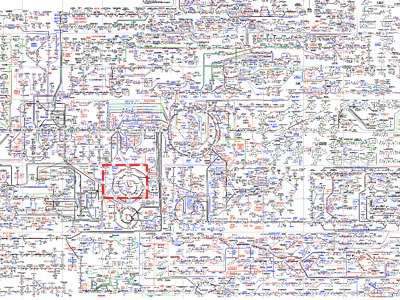
I’ve been meaning for a while to write something on this NY Times article asking if sugar is toxic. The basic gist is that sucrose (table sugar) is broken down into two sugars, glucose and fructose. Glucose feeds right into the glycolysis series and is therefore metabolized in any cell. Fructose, however, has to be processed by the liver, and its byproducts can go into any number of metabolic pathways. When there is a lot of fructose to process, the byproducts promote fat production, which can lead to fatty liver, insulin insensitivity, cardiovascular disease and cancer. Thus the question, “Is sugar toxic?”

The problem with this sort of question is that it totally ignores the biochemical realities of the body. I’ve been helping my daughter with high school chemistry and reviewing Le Chatelier’s principle, which is that a chemical equilibrium will shift according to changes in reactants or products. The body’s metabolic pathways are a complex, interlocking, massively buffered system that allows us to thrive with all sorts of shifts in food supply. The buildup of some fructose biproducts will shift chemical equilibriums and funnel those chemicals into pathways where they can be disposed. The buildup of fructose biproducts only becomes a problem if there is a lot of fructose to deal with and a lot of other calorie rich foods that block those disposal pathways. If calorie consumption is light, the body will utilize fructose very well and it will not be toxic. A lot of water is toxic and can kill you. A lot of alcohol in the blood is toxic, but if you have every been working really hard on little food and then chug a beer you will hardly feel the effects, because the body metabolizes the ethanol immediately for energy. To call sugar toxic in all situations is an overstatement.

Posted in Diet and Exercise, Science and Medicine | Leave a comment

ASU President Michael Crow and leading with emotion

I was just down in Arizona on Monday doing and interview with ASU President Michael Crow for a magazine piece. He is a very interesting person, a promethian character who has set out to transform ASU and higher education in general. His greatest ambition is to bring more underrepresented students into the university at the same time as he raises the standing of the university as a serious and accomplished educational institution. Most universities will try to do one or the other–raising standards and becoming more exclusive and selective, or lowering standards (although they never say this) to bring in and keep more students who otherwise not be admitted. And Crow seems to be succeeding.

The way he is doing this is by leveraging what they have to massively invest in infrasturcture and programs, making sure that all the programs work together and have high standards, and getting much more funding from federal research sources.

What is really interesting to me is that he is obviously a very emotional guy and deep down what he does is driven by emotion. A key factor in his life was that his mother died when he was around 11 and as the oldest child he had to take over a lot of the household duties. But he approaches everything in a very analytical way and doesn’t seem to have much regard for emotional approaches. He is not a politician, a profession that is driven by emotional connection. He once got kicked out of Governor Janet Napolitano’s office when she called him in to chew him out and he said “are you going to respond to the facts or respond to your emotions.” She slammed the door behind him so hard that her security detail came running, thinking it was a shot.

My guess is that he is discovering or rediscovering the necessity of emotional leadership in change. At the end of the interview I asked him what advice the 55 year old Crow would give to the 45 Crow who started the job ten years ago. And he said that he had come to realize the importance of making sure the students achieve, rather than just setting up a system and structure that allowed achievement. I took that to mean that he needed to inspire the desire to achieve among the students, not just making it possible for them to do well, but making them believe and strive to get there. You can design the perfect engine, but emotion is the fuel that makes it run.

Posted in Uncategorized | Leave a comment

Putting anthropological running theory to the test

One of the theories about why humans are such good runners is that they are built to run run long distance so that they can run down game. Other animals can go much faster in short bursts, but inevitably their muscles will overheat and fatigue, while human muscle sheds heat well and can keep going for miles. Early hominids, the theory goes, would simply have to keep chasing the gazelle and eventually they would catch it.

I have to admit I doubted this could be really true. But Outside magazine did an actual test with marathon runners chasing an antelope in the desert. Even the runners were surprised that after 20 miles they actually were able to get close enough to catch the antelope (although they didn’t).

I still think that one of the prime ways that running helped early hominids is in running to scavenge kills that other animals had made. They needed to be safely inside their Acacia fenced Kraals at night, so the growth of the tribe was limited by how far they could go in one day. I imagine that if they saw buzzards circling in the distance and could run there to chase away other animals before these other scavengers consumed the carcass, they could bring back a fair amount of food.

Posted in Science and Medicine | Leave a comment

Self improving computers inevitably take over

I had a fascinating coffee with my friend Steve Omohundro, a physicist, inventor and computer scientist. One of the areas he has done research on is self-aware systems and more particularly computer systems that change their own programming. What he found was that these systems inevitably change themselves in ways that we don’t predict. And this can be scary.

As an example, he cited a computer that is programmed to play chess. The computer may figure out more ways to fulfill its mission, for instance hacking into other computer systems to play more chess games. If it understands enough about the world, it may realize that more funding means that it can play more chess, so it may learn how to do phishing attacks or break into bank accounts. You might feel you can always unplug the computer, but if the computer knows enough about how thinks work it may find ways to prevent that. Self-improving systems can change so quickly and dramatically that they will inevitably cause problems. If they know enough about how the world works, they act in ways that are hard to stop.

Posted in Science and Medicine | Leave a comment

How to hack a job interview

There has been a lot of research on the psychology of persuasion, largely because of its links to advertising and sales. And that research has produced some really interesting results.

One of the most interesting aspects of persuasion is that once someone verbalizes something, they become very committed to that view. Once someone actually says “no,” its hard to get them to say “yes.”  It works the opposite way too–once someone says something nice about you, they become committed to that view.

You can work this to your advantage in job interviews. The trick is, when you first get in the room, say how happy you are to be here and how much you look forward to giving them the information they need, but first you are curious to know what it was that made them select you for an interview. After the interviewer states publicly and openly what it is they think makes you good for the job, they will spend the rest of the interview subconsciously finding evidence for that point of view, convincing themselves, in effect, that you are good for the job.

This little gem came from the author Robert Cialdini by way of Barking up the Wrong Tree.

Posted in Brain Hacking, Neuroscience and Psychology | Leave a comment