Running and the evolution of man (part 1)

Exercise builds the brain. Yet more strong theorizing summarized in this NY Times column:

Anyone whose resolve to exercise in 2013 is a bit shaky might want to consider an emerging scientific view of human evolution. It suggests that we are clever today in part because a million years ago, we could outrun and outwalk most other mammals over long distances. Our brains were shaped and sharpened by movement, the idea goes, and we continue to require regular physical activity in order for our brains to function optimally.

The column talks about a paper in Nature on “Endurance Running and the Evolution of Homo,” and the idea is that the human species succeeded because, although we couldn’t run the fastest, we could keep running after prey until they dropped dead from exhaustion.

I have been extremely skeptical of this idea until I saw an article in Outside magazine in which they got a group of endurance marathoners in New Mexico to actually do this with a pronghorn antelope, a very fast animal.

Tomorrow, I will look at another possible reason humans may have evolved endurance running, a reason cited in the Nature paper but not mentioned often in the press.

via Exercise and the Ever-Smarter Human Brain – NYTimes.com.
Posted in Neuroscience and Psychology, Science and Medicine, Sleep | Leave a comment

Four techniques Navy Seals use to make it through rigorous training

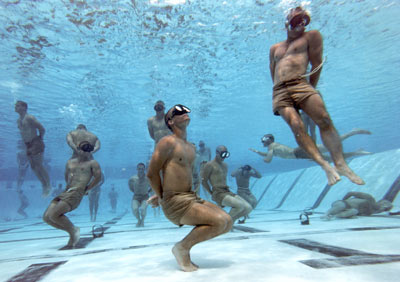
The training for Navy Seals is extremely tough. For instance, recruits have to stay underwater for 20 minutes. They have a hose to breath from, but they have to deal with regular attacks from instructors who rip their masks off, tie their air hose in knots and generally harrass them. The trick is not to panic but to stay calm, work out the problems and await the next harrasser.

In his blog, psychologist Bakari Akil II talks about how too many good Seal candidates weren’t making it through training because they were panicking, so the Navy taught the Seals four psychological techniques that improved passing rates. Anyone can use them.

Goal Setting:

The recruits were taught to set goals in extremely short chunks. For instance, Akil notes that one former Navy Seal discussed how he set goals such as making it to lunch, then dinner.

Mental Rehearsal:

The seal candidates were taught to visualize themselves succeeding in their activities and going through the motions.

Self Talk

We talk to ourselves in our heads all the time. Akil says that we use say 300 to 1000 words a minutes to ourselves. When recruits worked to make this internal self talk positive they could override their fears.

Arousal Control

The recruits were taught how to use breathing to control strong emotions that arise from primitive parts of the brain.
via How the Navy Seals Increased Passing Rates | Psychology Today.

Posted in Brain Hacking, Diet and Exercise, Neuroscience and Psychology | Leave a comment

Sugar is only toxic sometimes

IMG_1055Finally, a very sane analysis of what sugar does in your body. Robert Lustig, who is most famous for saying “Sugar is toxic,” lays out the case in a more sensible, less sloganistic fashion by saying that the fructose in sugar can be toxic if consumed chronically in large amounts or with an excess of calories. If you have low calorie consumption the fructose will not be converted to fat in the liver, which is the real problem. Is that so hard to say, instead of the misleading, shrill, blanket statement, “Sugar is toxic”?


What You Need To Know About Sugar | TIME.com.

Posted in Diet and Exercise, Science and Medicine | Leave a comment

The Meaning of Pupil Dilation

From The Scientist magazine, a really interesting roundup about pupil diliation and what it can tell us about human cognition. It’s an old subject, but finding many new applications and helping create new insights (no pun intended).

The Meaning of Pupil Dilation | The Scientist Magazine®.

Posted in Neuroscience and Psychology, Science and Medicine, Uncategorized | Leave a comment

Inherited Resistance to Cocaine

Male rat pups of cocaine using fathers are less likely to become addicted to cocaine and find the drug less rewarding, according to new research. This is due to inherited, epigenetic changes induced by the cocaine use.

“The findings, published today (16 December) in Nature Neuroscience, “were the exact opposite of what we expected,” said U Penn’s Chris Pierce, who led the study. His team showed that cocaine use leads to epigenetic changes in a rat’s brain that boost the levels of a protein called brain-derived neurotrophic factor (BDNF). These same changes are seen in the sperm of drug-taking rodent parents, and can be passed on to their male pups.”

As one researcher said, this is fascinating but scary. You can affect the way your children’s brain works through your own behavior.

“The results are sobering, pun sort of intended,” said Pierce. “The rats in our study were given access to cocaine for only 2 months, but this level of exposure was sufficient to significantly change the physiology and behavior of their male offspring.”

via Inherited Resistance to Cocaine | The Scientist Magazine®.

Posted in Brain Hacking, Neuroscience and Psychology, Science and Medicine | Leave a comment

Instagram Does an About-Face – NYTimes.com

Instagram reverts to previous rules. It took long enough.

In a blog post on the company’s site, Kevin Systrom, Instagram’s co-founder, said that where advertising was concerned, the company would revert to its previous terms of service, which have been in effect since October 2010.

For someone who apologized for not being clear in the TOS, Systrom was incredibly unclear in the first apology on Tuesday.

“We have no intention of selling your photos”

But they still could if they ever decided to.

“You own your photos.”

But if you have no control over how they are used, “ownership” is a distinction without a difference.

To be clear in their language, they should just say, “We will not sell your photos without your permission.” But they never did say that, did they?

via Instagram Does an About-Face – NYTimes.com.

Posted in Current History, Publishing and Journalism | Leave a comment

Grapefruit is a powerful drug

For 43 of the 85 drugs now on the list, consumption with grapefruit can be life-threatening, Dr. Bailey said. Many are linked to an increase in heart rhythm, known as torsade de pointes, that can lead to death. It can occur even without underlying heart disease and has been seen in patients taking certain anticancer agents, erythromycin and other anti-infective drugs, some cardiovascular drugs like quinidine, the antipsychotics lurasidone and ziprasidone, gastrointestinal agents cisapride and domperidone, and solifenacin, used to treat overactive bladders.

It’s interesting that grapefruit has such a powerful biological effect. That’s quite a lot of drugs that act differently when taken with grapefruit juice. I can’t think of another food product that has such an extensive biological effect on pharmaceuticals.

Grapefruit and Drugs Often Dont Mix – NYTimes.com.

Posted in Diet and Exercise, Science and Medicine | Leave a comment

BBC News – Instagram “suicide note” seeks right to sell access to photos to advertisers


Instagram signs its “Suicide Note.” They say you “own” your photos, but they can do whatever they want with it. What’s “ownership” without control?

A notice updating the privacy policy on the Instagram site said: “We may share your information as well as information from tools like cookies, log files, and device identifiers and location data with organisations that help us provide the service to you… and third-party advertising partners.”"To help us deliver interesting paid or sponsored content or promotions, you agree that a business may pay us to display your username, likeness, photos, in connection with paid or sponsored content or promotions, without any compensation to you,” it said in its terms of use.

So they could put your Instagram photo plus your name and photo on any advertising site with the caption, “Chris Vaughan enjoys watching beautiful sunsets like this while drinking Duff Beer.” All without asking your permission.

via BBC News – Instagram seeks right to sell access to photos to advertisers.

Posted in Current History, Publishing and Journalism | Leave a comment

More bad news for Ibuprofen during exercise

I’ve written about how ibuprofen may interfere with muscle development when taken after exercise, but it is not good to take during exercise either. For a while it has been known that it can cause people to ignore damage happening during the run because you can’t feel pain. Now, as cited in a New York Times article, it can also cause intestinal damage.

Posted in Diet and Exercise, Science and Medicine, Uncategorized | Leave a comment

Exercise protects the brain

Yet more evidence that exercise protects the brain against inevitable (but delayable) decline.


Posted in Diet and Exercise, Neuroscience and Psychology | Leave a comment