Exercise boosts the effectiveness of flu shots

Another benefit of exercise: researchers have known that it boost the immune system, and now there is evidence that it makes flu shots (and perhaps other vaccines?) more effective.

Those volunteers who had exercised after being inoculated, it turned out, exhibited “nearly double the antibody response” of the sedentary group, said Marian Kohut, a professor of kinesiology at Iowa State who oversaw the study, which is being prepared for publication. They also had higher blood levels of certain immune system cells that help the body fight off infection.

via Scope – medical blog – Stanford University School of Medicine.

Posted in Diet and Exercise, Science and Medicine | Leave a comment

Children’s behavior and bribes

In an op-ed piece in the New York Times, Bruce Feiler explores the widespread phenomenon of bribes (rewards) to get kids to do what they should, and the equally widespread belief that using such “extrinsic rewards” will actually undermine kids’ ability to do the right thing because behavior “should” be based on longer lasting “intrinsic rewards.”

I’ve come to agree with Steven Reiss that there is a mythological distinction between “intrinsic” and “extrinsic” rewards. The psychologists who continue to promote this distinction advocate reasoning with a child to get them to do the right thing, which in most cases doesn’t get you far at all (“you should eat your broccoli because it has lots of good flavenoids!”). What is your goal, as a parent? When you say you want kids to get intrinsic rewards for eating vegetables you are saying you want kids to feel good about eating them, to like eating them. But they don’t like them. They don’t feel good eating them. How to get from there to where you want them to be?

Provost Betty Phillips at ASU has done research showing that kids learn to like vegetables if you serve the veggies mixed with something they do like–a sugar syrup, a marshmallow mash, maybe just lots of butter. And after about five times they start to be able to like the vegetables and be able to eat them on their own. Some might say that this is a bribe. I say it’s training.

What we, as parents, are really trying to do is create an unconscious, positive association with eating that vegetable. Liking the vegetable, wanting to eat it–that is really what is meant by an “intrinsic reward.” But that association has to be built through training. It is a product of specific types of behavioral reinforcement. “Bribes” are perfectly fine if applied in the right way, although you can also get the same effect through games, through fun competition and praise–”you ate it faster than me–high five!!”

I remember that I learned to like cauliflower when I sat at the plate with the “good” fork (don’t ask) while on vacation, a plate that was intended for my father and which had half a head of cauliflower (he likes cauliflower). I was informed that if I was going to sit there I had to also eat what was on the plate. And I did. I ate the half cauliflower and found that I actually liked it.

Bruce Feiler starts his article by saying he wants to find more creative bribes, but he doesn’t get creative enough. The key is that we are doing behavioral modification on our kids, and bribes can be a legitimate part of that if they are used correctly.


Modifying a Child’s Behavior Without Resorting to Bribes – This Life – NYTimes.com.

Posted in Brain Hacking, Diet and Exercise | Leave a comment

Data visualization

I attended a fantastic data visualization workshop at USF over the weekend. It was taught by Peter Aldhous of the New Scientist. We learned how to take Excel spreadsheets of data and turn it into visualizations like the one I did at this link:

http://public.tableausoftware.com/views/HurricanePaths/Dashboard1?:embed=y


Posted in Publishing and Journalism, Science and Medicine | Leave a comment

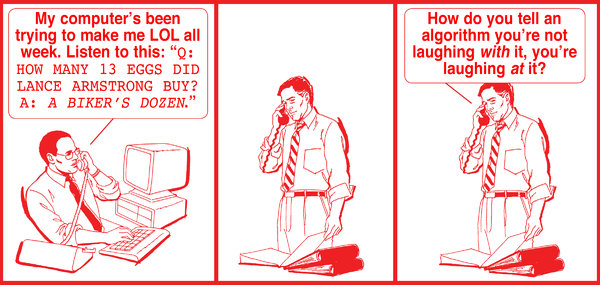
Can Computers Be Funny?

Can Computers Be Funny? - NYTimes.com

WHAT do you get when you cross a fragrance with an actor?Answer: a smell Gibson.


This is the kind of thing that passes for humor from a computer. It’s the kind of joke that would be a knee slapper for 8 year olds. Perhaps computers will grow funnier as they grow more advanced. I have always felt that we find something funny because we rapidly cut the cognitive distance or tension between ideas.

via Can Computers Be Funny? – NYTimes.com.

Posted in Brain Hacking, Neuroscience and Psychology | Leave a comment

We only see changes in ourselves in retrospect

From the New York  Times, an article on how we see how different we were in the past, but we don’t expect ourselves to change much in the future.

“Middle-aged people — like me — often look back on our teenage selves with some mixture of amusement and chagrin,” said one of the authors, Daniel T. Gilbert, a psychologist at Harvard. “What we never seem to realize is that our future selves will look back and think the very same thing about us. At every age we think we’re having the last laugh, and at every age we’re wrong.”

via Study in Science Shows ‘End of History Illusion’ – NYTimes.com.

Posted in Neuroscience and Psychology | Leave a comment

Learning while sleeping: infants do it

At one time there was a mania for learning while sleeping. People played recordings of physics lectures while they slept in hopes of learning during the brain’s down-time. Later science showed that these techniques did not work. There is a lot of memory consolidation during sleep, and certain things you do while awake can improve that process, but learning completely new material did not seem to happen during slumber.

But more recent science has shown that learning during sleep does work in one population: newborn infants. William Fifer at Columbia University in New York has shown that infants can learn social and other cues while they sleep.

Which means that the general environment for babies is important even while they sleep. And the the biggest danger from parental arguing in the home might not just be that you might wake up the baby.

Posted in How Life Begins, Science and Medicine, Sleep | Leave a comment

Seth’s Blog: The attention paradox

Seth Godin on the often antithetical demands of messaging in the information age.

Smart advertisers, though, are realizing that they have to make content that people decide is worth watching. Some have very good indeed at making media that’s so entertaining that we not only want to watch it, but spread it.

The challenge is that all those hoops you need to jump through to attract attention might be precisely the opposite of what you need to do to cause action, to get someone to change her mind or to connect.

via Seth’s Blog: The attention paradox.

Posted in Brain Hacking, Neuroscience and Psychology, Publishing and Journalism | Leave a comment

5 Big Discoveries About Personal Effectiveness in 2012

From Psychology Today’s website, an article listing 5 things you can do to be more effective.

• We don’t know ourselves as well as we think, so when we are not doing well at something, get feedback from others.

• If you are trying to solve a big problem, distracting yourself from it sometimes works best.

• We are more creative if we think about how others would solve a problem than if we think about how we would solve something.

• Get adequate sleep, although you can short yourself temporarily if you are on a roll.

• Time the type of work you are doing to be in tune with your body’s circadian rhythms.

In summation, the writer says:

it turns out that if you want to be most effective, letting go of the need for your own conscious mind to do all the problem solving might be the key. Let your unconscious do more work, whether through napping or distractions, and try seeing things through the eyes of others. Finally, quite counter-intuitively, perhaps others know more about us than we do ourselves. 

5 Big Discoveries About Personal Effectiveness in 2012 | Psychology Today.

Posted in Brain Hacking, Neuroscience and Psychology | Leave a comment

Why the obsession with apocalypse? The future is bright.

On this New Year’s Day, it is fitting to ask: Why are so many people obsessed with apocalypses? Why do so many people not only believe ridiculous things like the Mayan Apocalypse, but seem to want to believe them? On Boing Boing, Aengus Anderson says he has an idea.

Behind much of the apocalypse talk and the questionably-ironic zombie preparation classes at REI is a sense that something fundamental is out of balance. It may be impossible to articulate but, on a low level, we feel a sense of disquiet.

I began thinking about disquiet as I was working on two sprawling radio projects. After recording long conversations with nearly four hundred strangers about the past and present, I began to hear a common refrain rise out of the clamor: the future was scary. Nobody could agree on the cause, but they shared a narrative structure.

Having such a dark view of the future that apocalypse seems like a welcome outcome seems foreign to me. But then, I don’t have such a dark view of the future. I think that humans will adapt–it’s what we have always done to become the dominant species on the planet. During the Black Death, the world really did seem to be coming to an end, I’m sure. But centuries later, Europeans were still around, producing the Renaissance and doing just fine, thank you.

I think our problems now pale in comparison to a plague that kills 25% of the population. We have an amazing societal transformation underway now as we incorporate computer technology in the very fabric of our everyday lives. We’ve got problems; we may have to abandon large areas of coastline, there may be famine or massive bird flu epidemics. But we will make it through. The future is bright for the human race.

via Test Driving the Apocalypse – Boing Boing.

Posted in Current History, Neuroscience and Psychology, Science and Medicine | Leave a comment

Running and the evolution of man (Part 2)

250px-Survivor.africa.logoI distinctly remember watching Survivor: Africa in 2001 and realizing how vulnerable early man must have felt. The Survivor contestants were sleeping in a traditional african Kraal, which was simply a circular fence of thorny acacia bushes. At night, lions would circle the fence, roaring, growling and looking for an opening. With no claws or horns, thin skin and slow upright running, early hominids were incredibly vulnerable to predators when the drying climate cleared the forests and left man on the open savanna in ancient Africa.

Yesterday, I looked at one reason that early homo may have evolved to run, which was covered in the Nature paper Endurance Running and the Evolution of Homo. That idea is that humans evolved to run down prey by running it to exhaustion, most prey animals being good at sprinting but not at endurance running.

Survivor: Africa brought to mind the other possible reason, which is summarized in the Nature paper:

Another hypothesis to explore is that ER (endurance running) was initially useful for effective scavenging in the open, semi-arid environments apparently inhabited by early Homo. If early hominids were regularly scaven- ging marrow, brain and other tissues from carcasses, then ER would have helped hominids to compete more effectively for these scattered and ephemeral resources.

KraalPicture this: early hominids have to sleep every night. They can’t climb in trees and jump from limb to limb to get away from predators, because the forests of Central Africa have disappeared. On the open savanna, they construct fences of thorn bushes (the traditional African kraal) to live in, journeying out to get food. If they spot vultures circling in the distance, they know there is a fresh kill that they can run to and beat hyenas or lions to the feast (or chase them off by throwing stones). The growth of the community is limited by how far groups of scavengers can run and return in one day, so humans evolve the ability to run fast (but not sprinting-fast) over long distances.

Humans may have evolved to run because we were the ultimate scavenger, not the ultimate hunter.

Posted in Neuroscience and Psychology, Science and Medicine, Sleep | Leave a comment